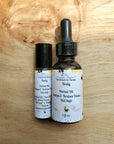
Arnica Flowers (Arnica montana)
Arnica is one of the most recognizable herbs in traditional European topical herbalism, particularly for its long history of use in preparations associated with bumps, bruises, and physical exertion. Its cheerful yellow flowers contain a variety of naturally occurring constituents, including sesquiterpene lactones, flavonoids, and phenolic compounds. Helenalin, one of arnica's best-known constituents, has been extensively studied for its biological activity and is also associated with the plant's potential to cause skin sensitization. Traditionally, arnica flowers have been infused into oils or prepared as liniments and salves for external application. I chose arnica as one of the two foundational herbs in this formula because of its longstanding place in traditional topical herbalism and its particular association with everyday bumps and bruises. Arnica preparations should only be applied to intact skin, as the herb can cause irritation and should not be used on open wounds.
St. John's Wort (Hypericum perforatum)
St. John's wort is another remarkable botanical with a rich history of traditional topical use. Although many people recognize it primarily as an herb taken internally, its flowering tops have also been infused into oil for generations. Traditionally prepared St. John's wort oil often develops a beautiful reddish color, reflecting the extraction of certain naturally occurring plant pigments. The plant contains a complex collection of constituents, including hypericin, hyperforin, and flavonoids, although their concentrations and stability vary considerably depending on the preparation method. In traditional European herbalism, St. John's wort oil has been associated with topical preparations for skin and body care, particularly following everyday physical activity and minor knocks. I chose to combine it with arnica because these two herbs have complementary histories in traditional external herbal preparations. Together, they create a simple infusion rooted in longstanding herbal practices.
Apricot Kernel Oil (Prunus armeniaca)
Apricot kernel oil is a beautiful carrier oil pressed from the kernels of apricots. It is naturally rich in fatty acids, particularly oleic and linoleic acids, which contribute to its soft, emollient feel. I appreciate apricot kernel oil because it spreads easily across the skin without the heaviness of some other botanical oils. Its smooth texture makes it especially pleasant for gentle, targeted massage. Apricot kernel oil also helps condition the skin and reduce moisture loss by supporting the skin's surface barrier. I chose it as part of the base for Bumps & Bruises because it provides excellent glide while allowing the herbal infusion to remain the focus of the formula.
Sunflower Seed Oil (Helianthus annuus)
Sunflower seed oil is a wonderfully versatile botanical oil with a long history of use in skincare. Depending on the variety, it contains different proportions of oleic and linoleic acids, along with naturally occurring minor constituents such as tocopherols. Linoleic acid is an important component of the skin's natural lipid structure, making linoleic-rich sunflower oil particularly interesting in skin-conditioning formulations. Sunflower seed oil is generally lightweight and spreads comfortably over the skin, making it an excellent choice for herbal infusions. I particularly appreciate how well it pairs with apricot kernel oil, creating a balanced base that feels nourishing without being overly heavy. Together, these oils provide a lovely medium for infusing arnica flowers and St. John's wort.
Vitamin E (Tocopherol)
Vitamin E is a fat-soluble antioxidant commonly incorporated into oil-based skincare formulations. It helps slow the oxidation of susceptible oils, which can contribute to rancidity and changes in aroma or quality over time. Vitamin E is also naturally present in the skin, where it plays a role in protecting lipids from oxidative stress. In Bumps & Bruises, I include a small amount primarily to support the stability and freshness of the botanical oils. It also contributes skin-conditioning properties to the finished formula. Vitamin E is an antioxidant, not a broad-spectrum antimicrobial preservative, which is an important distinction when formulating water-free products.
Rosemary Oleoresin Extract (ROE) — Salvia rosmarinus (syn. Rosmarinus officinalis)
Rosemary oleoresin extract, often abbreviated as ROE, is a concentrated botanical extract used to help protect oils from oxidation. Unlike rosemary essential oil, which is primarily valued for its aromatic volatile compounds, ROE is typically selected for its antioxidant constituents, particularly compounds such as carnosic acid and carnosol. These compounds help slow oxidative deterioration in oil-based formulations, supporting the quality and shelf life of the finished product. Only a very small amount is needed, which is why I describe it as a touch of rosemary antioxidant extract. I chose to combine ROE with vitamin E to provide additional antioxidant support for the apricot kernel and sunflower seed oils. This helps preserve the character of the herbal infusion without adding essential oils or fragrance.
These descriptions reflect traditional herbal use and formulation principles rather than intended medical outcomes.